CATL 46.6kWh 166V LFP Battery Pack Module M52280-E (770154-00204)
Technical Specifications
Product Details & Description
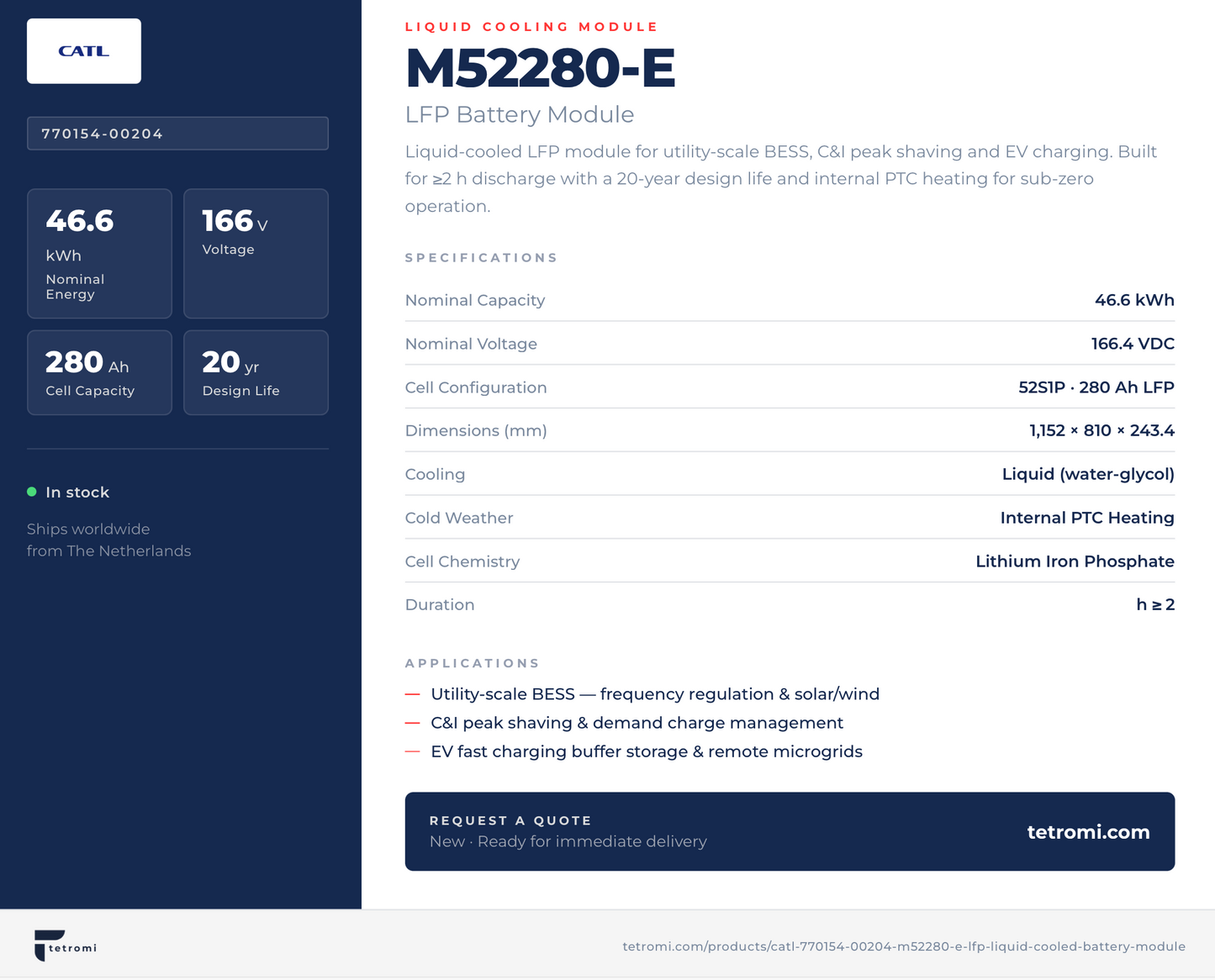
The CATL 770154-00204 (Model M52280-E) is a high-capacity Liquid Cooling Module designed for long-duration energy storage systems. As a core component of CATL’s professional EnerOne and iCube product lines, this module is engineered for high-density applications requiring 2-hour or greater discharge durations.
Technical Core
The module utilizes a 52S1P configuration of 280 Ah Lithium Iron Phosphate (LFP) prismatic cells. This chemistry provides superior thermal stability and a design life of up to 20 years. With a nominal energy of 46.6 kWh and a voltage of 166.4 VDC, these modules are designed to be stacked in series to reach the 1000V–1500V thresholds required by utility-scale inverters.
Advanced Thermal Management
Unlike air-cooled units, the M52280-E features a sophisticated liquid-cooling architecture (water-glycol mix) that maintains cell temperature uniformity. This eliminates the "bucket effect" of uneven cell aging and maximizes system lifespan. For cold-weather reliability, the unit includes internal PTC heating strips that allow for safe charging in sub-zero environments when connected to an external auxiliary power source.
Industrial Applications & Integration
These modules serve as a versatile "building block" for various high-demand scenarios.
-
Utility-Scale BESS: Grid stabilization, frequency regulation, and smoothing intermittent wind/solar output, such as Wärtsilä GridSolv Quantum.
-
Commercial & Industrial (C&I): Peak shaving and demand charge management for large manufacturing facilities.
-
EV Charging Infrastructure: High-power buffer storage for ultra-fast charging stations to reduce grid strain.
-
Microgrids: Reliable backup and energy independence for remote industrial sites or islanded power systems.
Note: To deploy a functional system, you will require a mechanical frame (capable of supporting ~330 kg per module), an external liquid-cooling circulation loop with a chiller, and a multi-tier Battery Management System (BMS) for inverter communication.
Communication Protocol
The internal CSC utilizes the TPL, an isolated daisy-chain protocol developed by NXP. It provides high-voltage galvanic isolation and operates at a bit rate of 2 Mbps. This physical layer is often referred to in the industry as isoSPI.
CATL utilizes CAN bus (CAN 2.0B) and Modbus TCP/IP. Standard CAN communication for these systems is typically configured at 250 kbps. Modbus is utilized for granular data exchange and management by site-level controllers.
Battery Management System
CATL utilizes a three level BMS architecture for utility-scale systems: CSC (internal to module) —> SBMU (String Unit) —> MBMU (Master Unit). Third-party integration is the only viable path because CATL does not support individual retail sales of their master controllers.
The MBMU and SBMU are not available for retail purchase or as standalone units in the secondary market. These units are typically part of a factory-integrated rack assembly (like Wärtsilä GridSolv or EnerOne) and are not sold as individual parts to the public.
Surplus modules (such as these) sold individually are missing the original high-level management hardware (current sensors, contactor controls, etc.), which were located in the main rack control box rather than the module itself.
Because the original BMS is restricted, the standard practice is to utilize the module's access to the internal balance lead wires to connect a third-party master controller.
Third-party systems widely used to manage these CATL strings include: Orion BMS 2 (supports high-voltage strings and custom CAN programming), Batrium (WatchMon, specifically designed for managing various LFP cell configurations in large packs) and Ennoid.
Batrium and Orion systems include inverter profiles for brands like Solis, SMA, Deye, and Victron.
Shipping & Logistics